Transforming Gait Labs: The Future of Biomechanics
The field of biomechanics has steadily evolved since Bertec’s inception in 1987. For decades, biomechanics largely centered on capturing the fundamentals of body motion; forces, moments, and movement patterns in controlled settings.
The Evolution of Biomechanics
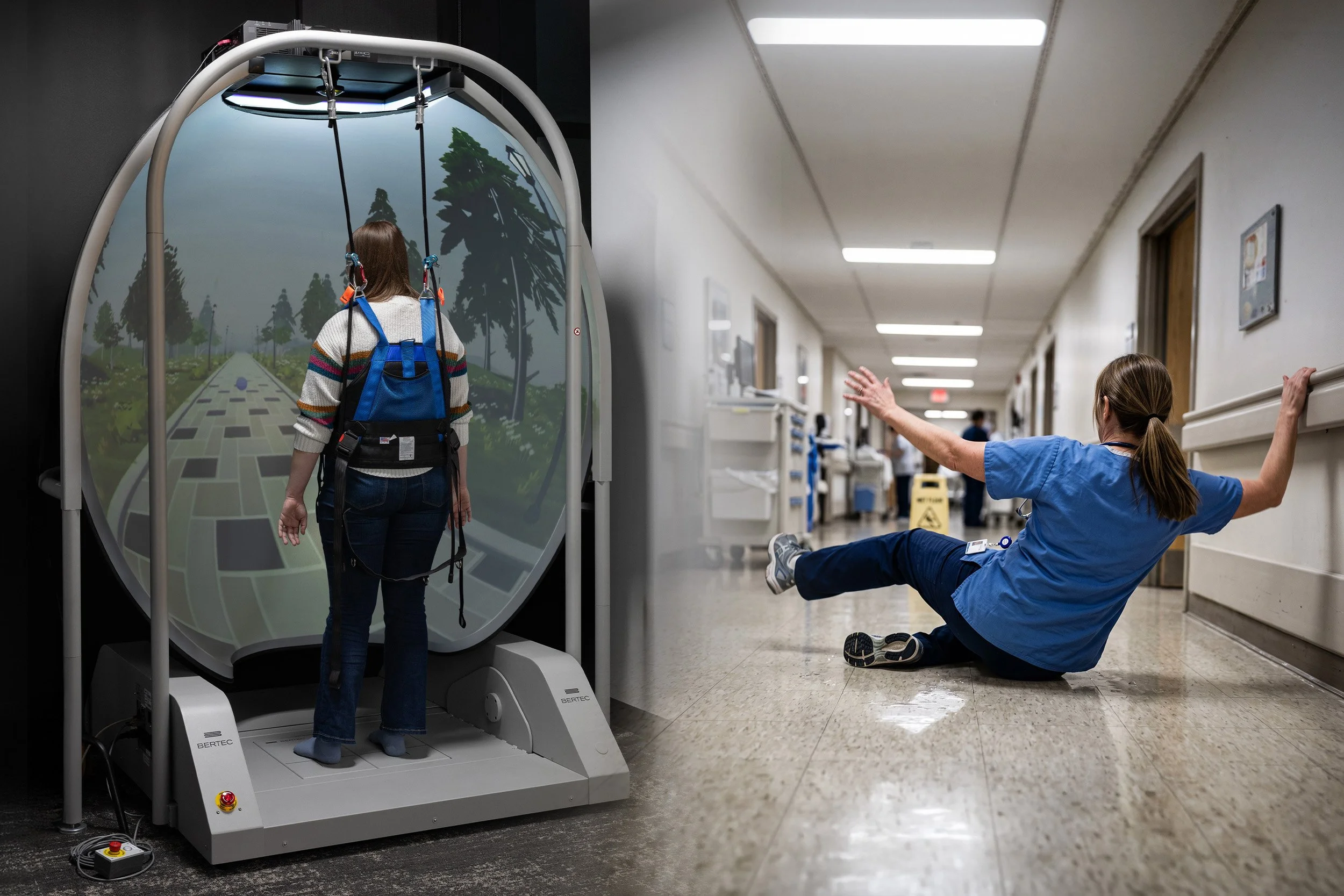
Today a fundamental shift is taking place. Researchers are no longer asking only how people move, but why they move the way they do in complex, unpredictable environments. Falls, missteps, and movement failures rarely occur in labs; they happen in crowds, on uneven terrain, under sensory conflict, or during moments of cognitive overload. Traditional tools can measure movement, but they can’t recreate the conditions under which real-world movement actually happens.
As our founder, Dr. Necip Berme mentioned in another piece in collaboration with Vicon, “Test subjects in a lab setting do not walk as they walk outside the laboratory: a lesson I learned in the 1970s,” and that lesson still holds true today.
Entering a New Era
Unable to reliably simulate these real-life stresses in conventional lab setups, researchers have naturally turned to virtual reality to recreate real-world challenges with precision, repeatability, and safety. This has prompted the field toward a new type of science: one that blends biomechanics with perception, cognition, and environment.
Bertec’s Role in Advancing Immersive Biomechanics
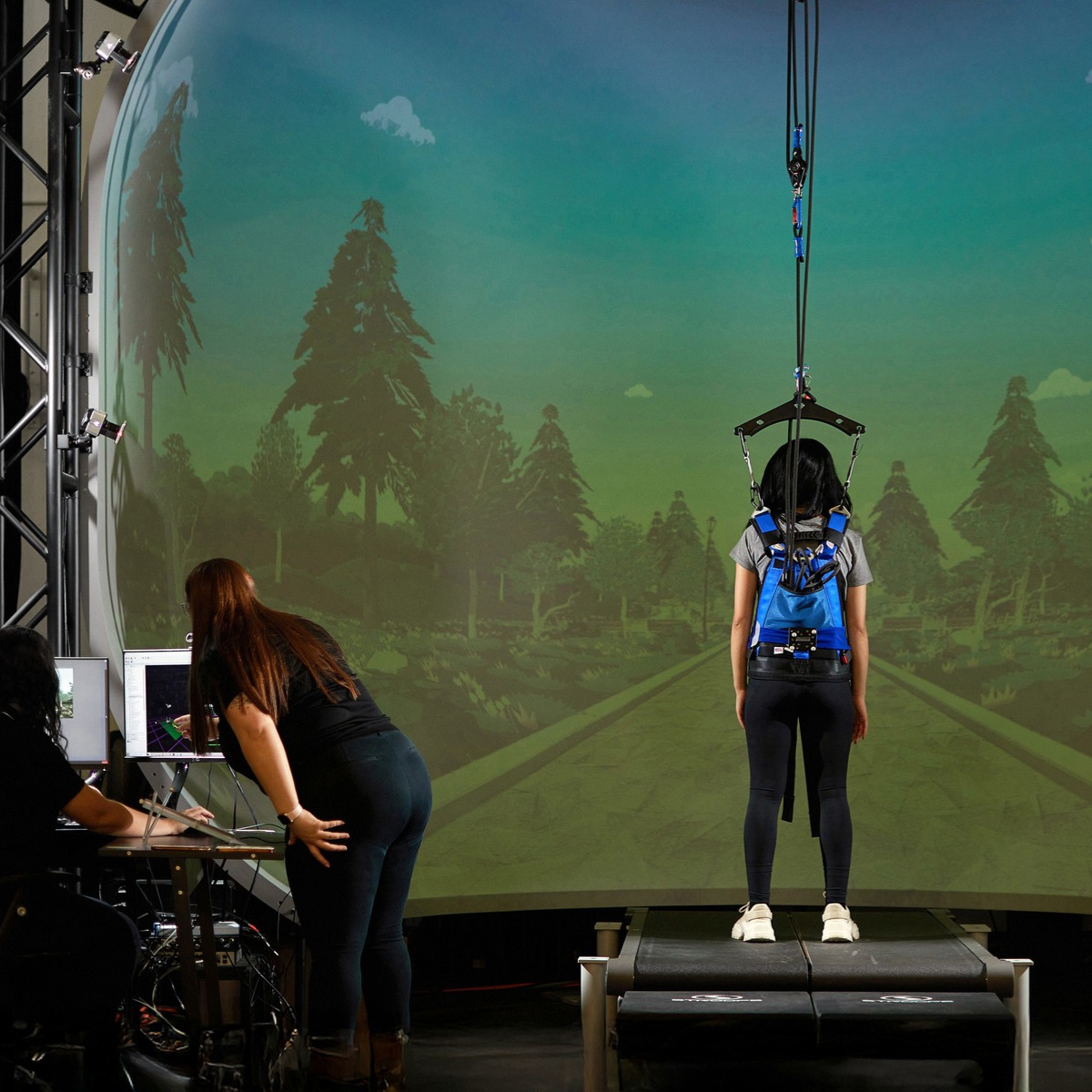
At Bertec, it’s been exciting to support this shift as it unfolds. As we recognized researchers’ growing need for controlled yet immersive experimental environments, we expanded our technology to include a suite of Virtual Reality solutions that integrate seamlessly with our instrumented treadmill—ranging from an affordable head-mounted display to a lab-filling 4-meter or 5-meter dome. This integration gives researchers a powerful platform to study human behavior in dynamic contexts: navigating crowds, responding to visual perturbations, adapting to simulated terrains, or interacting with virtual objects.
These aren’t just new tools. They are systems that enable new questions to be asked and answered. Today, biomechanics labs are beginning to explore how people make movement decisions, how perception shapes action, how visual motion alters stability, and how individuals adapt under sensory conflict or cognitive load. VR allows researchers to move beyond the constraints of the traditional lab and test the true complexities of human movement.
Whether it’s advancing rehabilitation strategies, improving athletic training, deepening our understanding of balance and perception, or exploring entirely new human–environment interactions, Bertec’s VR-enabled technologies help researchers push the boundaries of what’s possible.
Enabling Future Human Movement Insights
As biomechanics continues to evolve, so will we. Our commitment remains the same as it has been for nearly four decades: to empower researchers with precise, reliable tools and to help drive the next generation of insights into human movement.
Want to learn more about our virtual reality products? Connect with our team here.