Ground Reaction Force in Baseball Pitching
Every baseball game starts with one thing: the pitch. From celebrity mishaps to retired professional glory, the first pitch of the game highlights just how difficult it is to pitch at the highest level. So, what are the influential factors behind the world's best pitchers, and what can aspiring athletes focus on to achieve their goals?
To follow the research below, a few biomechanics terms are worth knowing upfront:
Footplant: The moment the stride leg touches the ground
Drive leg: The back leg; produces the initial push-off force
Stride leg: The front leg; stabilizes the pitcher and transfers force up the body
Peak elbow external rotation: When the elbow is rotated backwards as much as possible during the pitch at the end of arm cocking
Eccentric: Flexing a muscle while it gets longer, like the quads in the downward phase of a squat
The Impact of Force Generation
Ground reaction force (GRF), or the force the ground exerts on our body when we push on it, is the driving energy behind human movement. Explosive power is generated from the ground up. Objectively measuring the amount of force a player generates provides crucial information that cannot be seen with the naked eye.
This data can help answer one of the biggest questions in sports performance: "Is my player reaching their full potential?" But what constitutes effective force generation, and how can you break down the pitching motion to identify what to focus on? Researchers have used pitching mounds embedded with force plates to evaluate GRF across each phase of the pitch and its influence on pitching velocity and mechanics. Below, we cover key findings from peer-reviewed research and how this information can support pitching performance analysis.
Pitching Phase Breakdown
1. Pushoff/Stride Phase
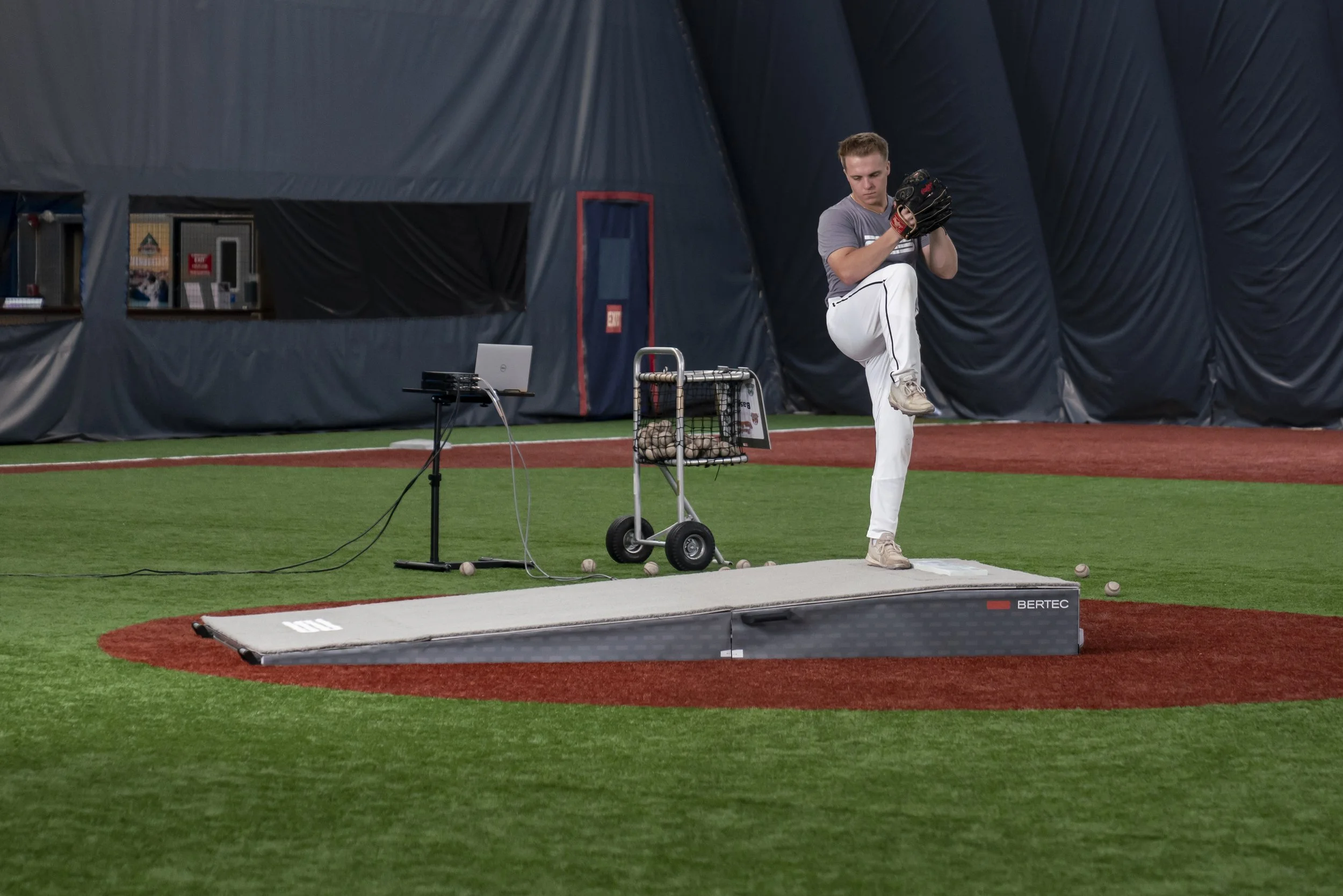
Duration: Peak knee height to foot plant
GRF peaks reach up to 1.3x body weight
Elite Players: Higher vertical GRF is related to higher pitch velocity
Developing Players: Small to no relationship between vertical GRF and pitch velocity
After winding up, pitchers balance on the drive leg and begin pushing force into the ground to propel themselves down the mound. From peak knee height to foot plant, they generate as much force as possible to create a foundation for energy transfer. This push off phase is characterized by a fast shifting of weight down the mound and the development of explosive force.
Published research offers a nuanced picture here. Elite players move their center of pressure (COP) throughout a large area, allowing for greater rotational capacity and longer periods of force development. In these high-performing athletes, more force generated in this phase correlates with higher pitch velocity. However, that relationship does not hold consistently in younger players. Researchers believe developing athletes may not yet be able to leverage that force due to inefficient mechanics. Force plates help clarify whether a performance issue is a technique breakdown or a strength deficit, so coaches can intervene with precision.
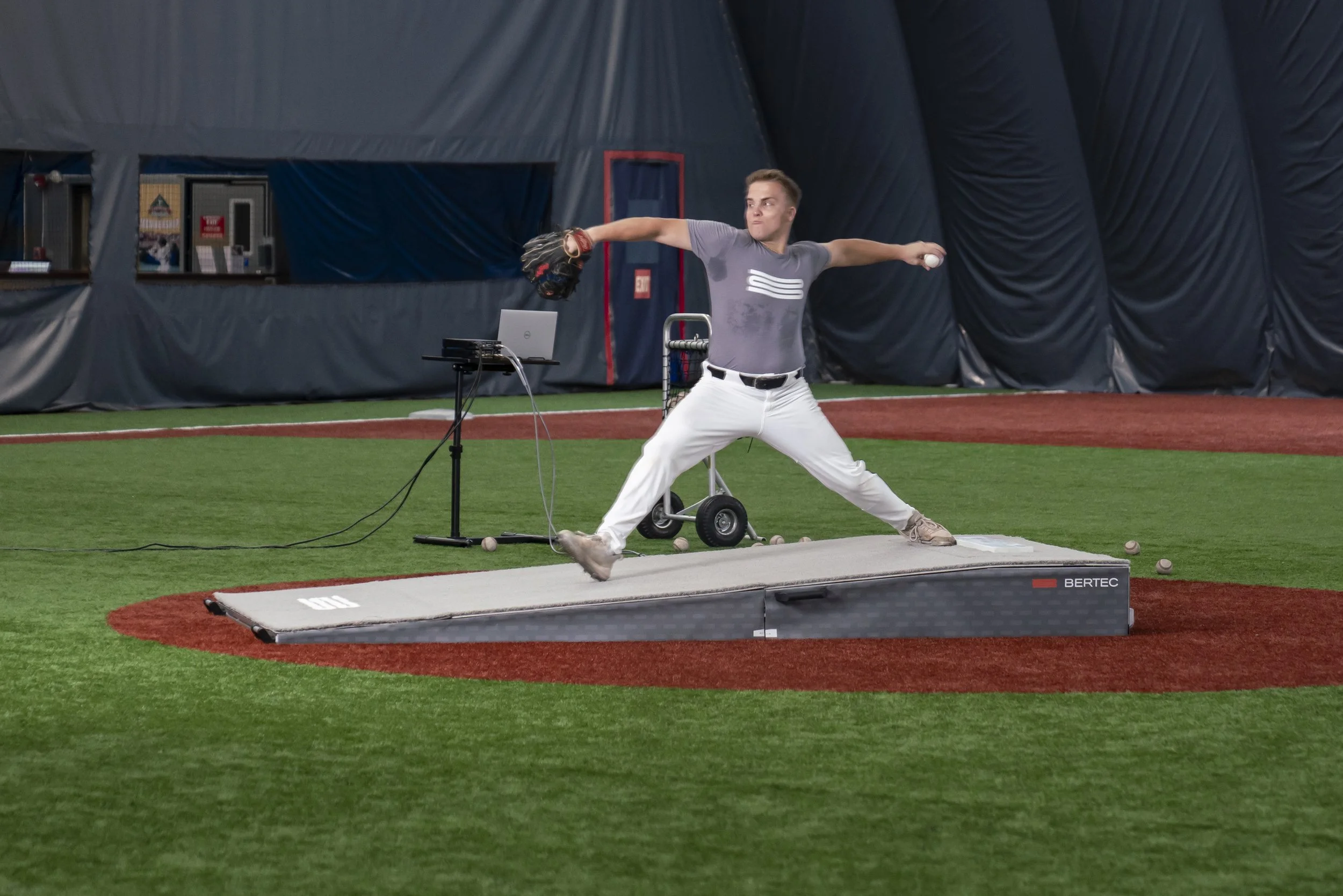
2. Arm Cocking
Duration: Foot plant to peak shoulder external rotation
Players begin to explode down the mound, rotating the arm until the shoulder reaches maximal external rotation
Nearly all components of ground reaction force are related to velocity in this phase
Braking (backwards) force is the most prominent indicator of pitch velocity and energy flow from the trunk into the arm
Once pitchers generate force in the pushoff phase, they fall down the mound and land with a large impact on the stride leg. They load this leg eccentrically, landing with a bend in the knee and firing the quads and glutes tostraighten it over the course of the pitch. Research shows that peak backwards braking force immediately after foot plant is most associated with pitch velocity. The greater the backwards force, the faster the pitch.
The backwards GRF stabilizes the stride leg, turning it into a lever over which the body rotates and transfers energy. It drives quicker knee extension, supports optimal lead leg blocking, and cues hip rotation at the right moment in the kinematic sequence.
3. Arm Acceleration
Duration: Peak elbow external rotation to ball release
This is the fastest phase of the pitch, where the arm rapidly accelerates forward through ball release
Medial and braking GRF during this phase correlates with wrist velocity, supporting rotational generation and proper kinematic sequencing
As the arm whips through the air, high-velocity pitchers accelerate the arm forward while extending the knee to a near-upright position at ball release. Research shows knee flexion angle at release differs significantly between high-velocity and low-velocity pitchers: the more upright the knee, the better the outcome.
Mediolateral forces in this phase are critical for generating the rotations that allow athletes to use mechanics, rather than raw muscle, to create speed. High-velocity pitchers leverage their GRF production and eccentric strength here to achieve optimal joint positioning and deliver fast pitches consistently.
Coaching Considerations
In baseball pitching, GRF metrics have the potential to surface unrealized performance gains and establish objective benchmarks for improvement. Force plate data helps coaches ask the right questions: is strength the limiting factor, or is there a mechanical breakdown leading to inefficient force transfer? A pitching mound instrumented with force plates provides the objective data needed to answer those questions and direct training accordingly. The future of athletic performance analysis is grounded in objective data that coaches can utilize to create meaningful changes.