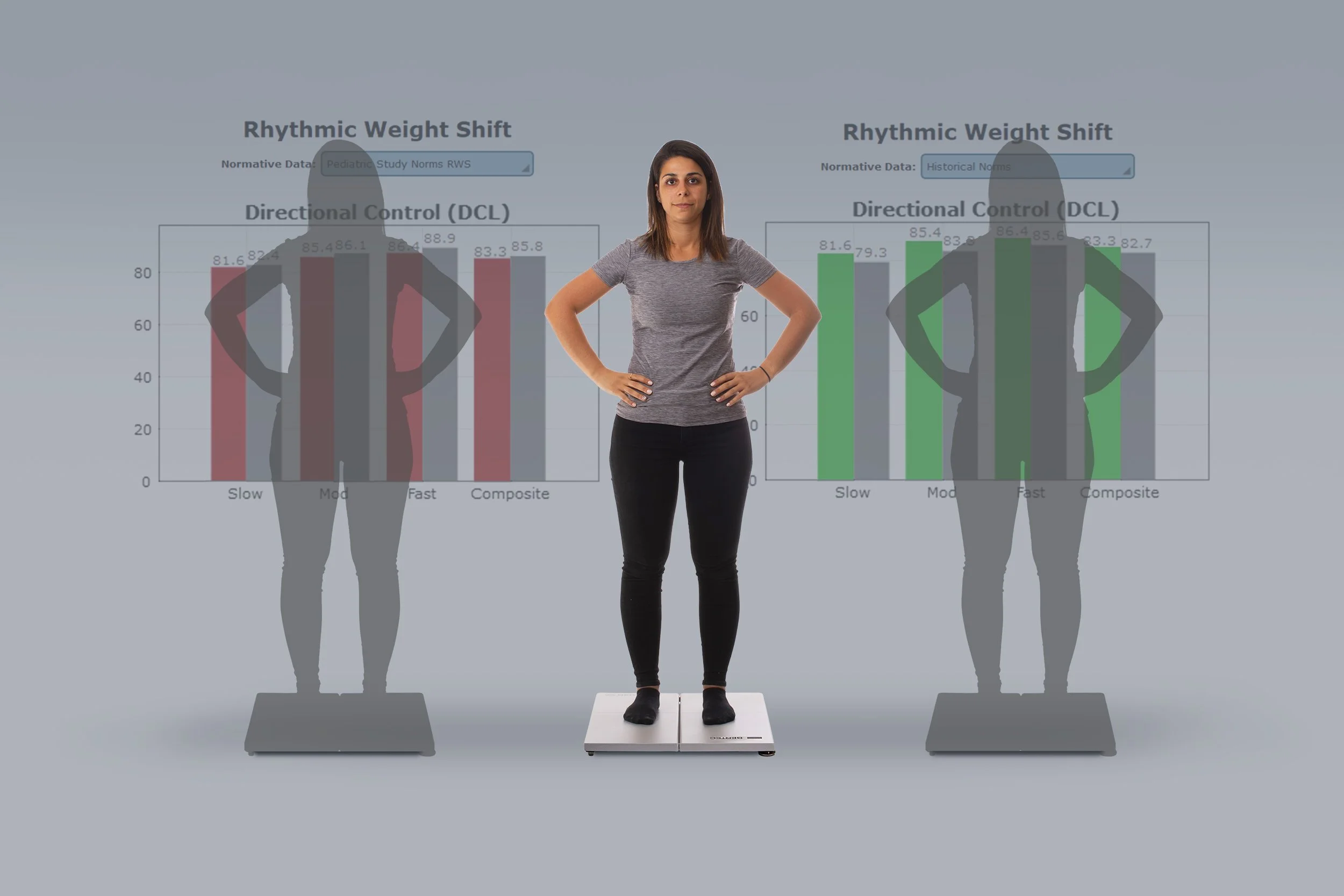
Making Balance Assessment Data Meaningful: How Normative Values and User-Defined Norms Improve Clinical Decision-Making
When a patient steps onto the force plate(s), Balance Advantage analyzes their movement and gives you objective balance assessment data—sway velocity, weight symmetry, latency, time to fall, rising index, and more. But what does that data mean for this patient, in this moment of care?
That’s where normative data and reference values come in—not to replace clinical judgment, but to support it. Normative data helps clinicians compare an individual’s balance testing results to a reference population, adding context to aid in clinical decision-making and determining next steps for intervention. While normative data has been widely used across many types of clinical assessments, its value is greatest when paired with the full clinical picture, including history, symptoms, diagnosis, functional performance, and your observations. In short, norms do not make the decision for you. They provide a consistent, evidence-informed benchmark that can sharpen interpretation, support communication, and strengthen progress tracking over time.
In other words: norms help you move from data to clinical relevance.
Why normative reference values improve clinical decision-making
Clinicians already do this kind of thinking every day, often without even realizing it. You naturally benchmark a patient against what is expected based on age, diagnosis, and functional level. Comparing balance assessment results to normative values makes that benchmarking more objective and repeatable.
Comparing patient results to normative reference values can help you:
Identify subtle impairments sooner. Small deficits that might not stand out in isolation become more apparent when measured against age-matched balance norms.
Prioritize what to treat. Normative comparisons help you see where a patient deviates most and direct your attention there. A patient's SOT sensory scores may fall within range for somatosensory input but below norms for vision and vestibular, pointing toward interventions like vestibular integration or sensory reweighting.
Track progress with confidence. A change in score is more meaningful when you can relate it to expected variability and the typical range for a comparable reference group—making interpreting balance test results over time more confident and defensible.
Of course, not all normative data is created equal. The quality of your clinical interpretation depends on the quality and relevance of the reference population behind those values — which is why it matters where your norms come from and how they were established.
The challenge: “one-size-fits-all” balance norms don’t fit every clinic
Balance norms are not universal. They depend on who was tested and how the test was run. Published research consistently shows that factors like age, sex, and even body composition influence postural control and balance performance — and those effects vary depending on the test itself. The rate and pattern of age-related decline differs across balance measures, and variability between individuals tends to increase with age, making a single set of cutoffs less reliable for older populations. Reference values developed in one demographic or geographic group don't automatically apply to another, and even balance testing normative data collected in a single lab may not generalize broadly.
The takeaway: the reference dataset you use in your clinic should reflect how you test, who you test, and the population you serve. That's why Balance Advantage includes Bertec-provided normative datasets as a strong starting point — while also giving clinics the ability to go further.
How user-defined normative data expands on Bertec-provided balance norms
Bertec’s age-stratified balance norms help standardize interpretation and provide immediate clinical context. They are grouped by age and available across all assessments in the software, giving clinicians a reliable starting point for identifying impairments and interpreting balance assessment performance right out of the box.
But no single dataset can represent every patient population. What counts as "expected" looks different for a vestibular clinic, a sports concussion program, and a geriatric fall prevention practice. User-defined norms let you close that gap — whether that means uploading population-specific reference values that better reflect your typical referral patterns, comparing athletes to sport-specific concussion baseline data rather than to the general population, or aligning interpretation to a well-defined local cohort so results are easier to communicate to patients and caregivers.
The payoff: better balance assessment interpretation, clearer reporting, smarter care
Balance Advantage helps you capture meaningful balance assessment data. Normative values help you interpret it. And user-defined norms help you personalize that interpretation—so your comparisons reflect your patient population, your protocols, and the latest evidence.
See how Bertec Balance Advantage can help you deliver more personalized, data-driven balance care here.